What you decide in a crash round
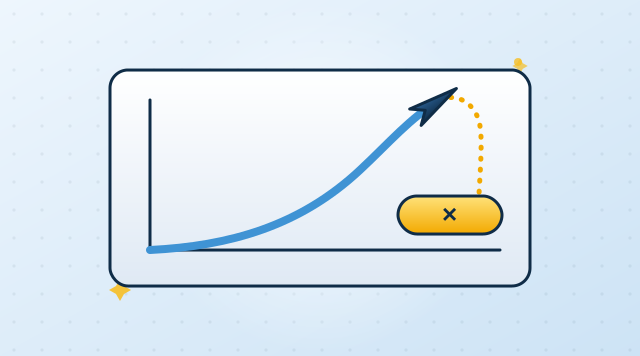
At a 97% RTP, reaching at least 2x happens in roughly 48 of every 100 rounds, and that figure tells you nothing about how your own session will end. You bet before the round starts, a multiplier climbs from 1.00x and you choose when to cash out; if the game “crashes” before you press, you lose the bet. Aviator, Spaceman and JetX share the idea and differ in theme and rule details.
Your only decision is the cash-out target. The crash point is set by the random number generator and does not depend on how much you bet or on earlier rounds. The crash games guide describes the category in general.
How likely is each multiplier?
If you always cash out at multiplier x, you win x times the stake with probability p and lose otherwise. The average return per ARS 1 staked is p × x. If the game returns the same RTP for any target, which one of the sources we reviewed states for Aviator, then p × x = RTP and the probability of reaching at least x is RTP / x. This is our own deduction, not a formula published by the provider. Not verified
With a 97% RTP, the result is:
- 1.5x: 64.7%. 2x: 48.5%. 5x: 19.4%. 10x: 9.7%. 100x: 0.97%.
- About 3% of rounds would end at 1.00x, before you can cash out.
The consequence is that every target costs the same on average. With ARS 1,000 and a 2x target: 0.485 × ARS 2,000 = ARS 970. With a 10x target: 0.097 × ARS 10,000 = ARS 970. The cost is ARS 30 per ARS 1,000 staked; what changes is the shape of the path, with small frequent prizes or large rare ones. The RTP also depends on the title: our pages cite 97% for Aviator, 95.5% for Spaceman in its help file (other sources give 95% or 96.5%) and 97% by default for JetX in a third-party listing. At 95.5% the cost rises to ARS 45 per ARS 1,000.
What happens over one hundred rounds at 97% RTP?
The RTP is the average over a very large number of rounds. One hundred rounds of ARS 1,000 with a 2x target means ARS 100,000 staked, and the average returns ARS 97,000: an expected cost of ARS 3,000. A real session is not the average. With a 48.5% hit rate, the exact distribution (our calculation, using the deduction above) puts 95% of one-hundred-round sessions between roughly −ARS 22,000 and +ARS 16,000, and about 34% finish above zero.
With a 10x target the RTP is the same, but the range widens to between −ARS 60,000 and +ARS 60,000. Around 38% of sessions finish ahead, around 13% finish exactly at zero (ten hits) and almost half finish with nine hits or fewer. Two sessions with the same RTP can feel completely different.
Two practical points. Finishing a session ahead does not change the cost of the next one. And a run of low crashes does not make a high multiplier more likely: if the generator is independent each round, the history on screen predicts nothing.
How many rounds fit in an hour
The pace is what makes budgeting hard. The sources we reviewed mention rounds of 5 to 30 seconds. If a round lasts 15 seconds (our assumption), that is about 240 rounds an hour: at ARS 1,000 per round you stake ARS 240,000, and the average cost at 97% is ARS 7,200 an hour; with two simultaneous bets, double. With a ARS 10,000 budget and ARS 500 bets you have 20 rounds, about five minutes.
So it helps to set the total before you start, pick a fixed cash-out target and stop when you reach the amount or the time you planned. Doubling after each loss fails for the same reason: with a 2x target, six losses in a row happen about 1.9% of the time (0.515⁶) and add up to ARS 63,000 of stakes (1,000 + 2,000 + 4,000 + 8,000 + 16,000 + 32,000). Wanting to recover with a bigger bet is the signal to stop.
“Provably fair”: what it proves and what it does not
It works as a cryptographic commitment. Before the round a fingerprint (a hash) of a secret seed is published; afterwards the seed is revealed and anyone can recompute the hash and the crash point. That proves the result was fixed before the bets and was not changed after seeing who had bet.
It does not prove the RTP is 97%: the same scheme works for a 94% game, and one round cannot tell them apart. Nor is it a laboratory certification, which examines the generator and the maths of a specific version of the game. For Aviator, secondary sources describe a server seed, seeds from the first three bettors and a per-round counter, but disagree on the exact algorithm (SHA-512 or HMAC-SHA256), and Spribe’s own page did not load when we tried it on 24 November 2026. On our pages, Spaceman’s help file dropped the description of that mechanic in 2024 and the SmartSoft texts on JetX do not mention it.
What remains unconfirmed
- Spribe’s own documentation, including its verification tool: everything comes from third parties.
- That the RTP / x formula holds in each title; it is a deduction.
- The real round length and the bet limits in pesos.
- Which laboratory certified each generator, and for which version.
- Which reviewed casinos offer crash games and whether they are enabled in your province. Betano documents a 20% contribution only for live and table games; for crash games Not verified. See wagering requirements before using a bonus on these games.
The same reasoning about the cost of each bet applies to sports betting: read how to read a decimal price and the house margin.
The per-multiplier probabilities and session ranges are our own calculations, not provider data; for Aviator we could only read third-party sources (consulted on 24 November 2026).
Content for adults aged 18 and over. Gambling is not a way to make money. Si necesitás ayuda, la Línea 141 (Sedronar) está disponible; más información en juego responsable.





 Responsible gambling


