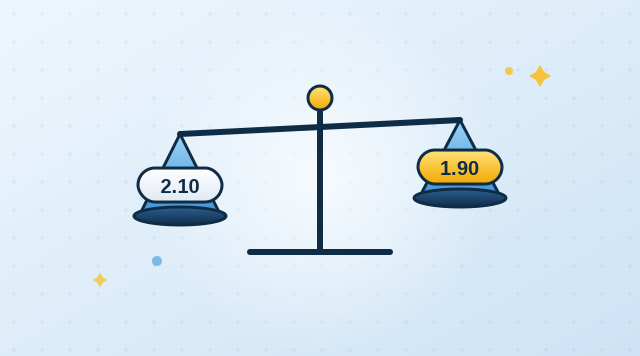
A decimal price includes your stake
A decimal price is what you collect per peso staked if the bet wins, and that collection already counts the peso you put in. An assumed example: at 2.10, a stake of ARS 10,000 returns ARS 21,000 in total, of which ARS 11,000 is profit. Mixing up payout and profit is the commonest mistake; profit is (price − 1) × stake.
We use this format across the site. Some operators let you switch formats, and if you see 5/4 or +125 the arithmetic differs: convert before comparing. We also leave out payment-method fees and taxes, which we could not verify. Not verified
What probability the price is paying for
Dividing 1 by the price gives the implied probability: at 2.10, 1 / 2.10 = 47.6%. Read it as a break-even point: to avoid losing over the long run, you would have to be right 47.6 times in 100. If you believe the event happens 50% of the time, the expected value would be 0.50 × 2.10 − 1 = +0.05, that is ARS 500 per ARS 10,000. But that 50% is your estimate, not a fact, which is why no bet comes with a guaranteed result.
Working out the margin in a three-outcome match
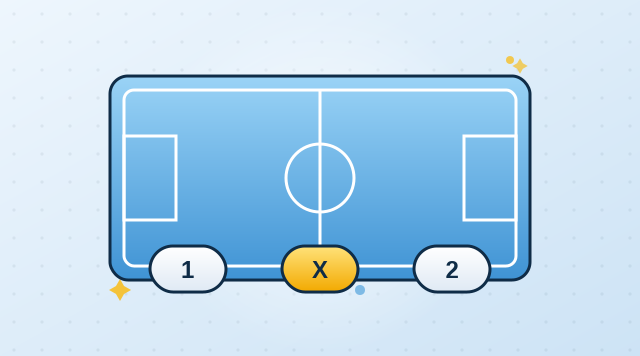
Take assumed prices, not from any operator: home 2.10, draw 3.30, away 3.60. The implied probabilities are:
- Home: 1 / 2.10 = 47.62%.
- Draw: 1 / 3.30 = 30.30%.
- Away: 1 / 3.60 = 27.78%.
They add up to 105.70%. If the prices were fair they would add up to 100%. The 5.70% excess is the bookmaker’s margin, called the overround in the market. It takes three steps: 1) divide 1 by each price, 2) add them up, 3) subtract 1.
What that 5.7% costs you
The inverse of the sum, 1 / 1.057, gives 94.6%: what the market returns on average if you spread your money across every outcome, much like a game’s RTP. Spread ARS 10,000 that way and the average cost would be ARS 539, with ARS 9,461 coming back. To estimate a probability without the margin, the simplest way is to divide each implied probability by the sum: 47.62 / 1.057 = 45.05%, 30.30 / 1.057 = 28.67% and 27.78 / 1.057 = 26.28%. The “fair” prices would be 2.22, 3.49 and 3.81. It is an approximation: other methods spread the margin differently, for example loading more onto the less likely outcomes, and operators do not publish how they do it.
Two-outcome markets have one too. Two prices of 1.91 add up to 104.7% (1 / 1.91 × 2), a margin of 4.7%.
Two operators, the same match
Suppose another operator offers 2.15, 3.20 and 3.40 for the same match. The sum is 46.51% + 31.25% + 29.41% = 107.17%: a margin of 7.17% and a return of 93.3%. On ARS 10,000, the difference in average cost between the two is about ARS 130. On the home win the second pays more (2.15 against 2.10); on the draw and the away win, less. If you estimate the away side at a 30% chance, the expected value at 3.60 would be 0.30 × 3.60 − 1 = +0.08 and at 3.40 it would be +0.02: the same estimate is worth different amounts at different prices, though it remains your own estimate. So looking only at the price of what you want to bet is not enough: the market’s total margin tells you what the operator charges, and your selection’s price tells you what it pays for it.
Real margins change by match, by league and by moment, and we do not measure prices systematically, so there is no operator ranking here. What you can do is repeat this sum with the prices you see on the same match at the same minute. The sports betting section and the football markets guide explain the markets; the glossary defines the terms.
Where else this margin shows up
It does not stop at a single bet. In an accumulator it multiplies leg by leg, as we show in accumulators: the mathematics of risk. In-play it changes with every move, and cash out applies it again: read live betting and cash out. And each football market has its own settlement rules, summarised in football markets: 1X2, double chance and handicap.
What is still unconfirmed
- The price format each reviewed operator displays.
- Whether the operator withholds taxes or fees on the payout, or whether the payment method charges them.
- How each operator spreads its margin across the outcomes of a market.
Every price in this article is assumed, chosen so the arithmetic is easy to follow; none is a real operator price.
Content for adults aged 18 and over. Gambling is not a way to make money. Si necesitás ayuda, la Línea 141 (Sedronar) está disponible; más información en juego responsable.



 Responsible gambling


