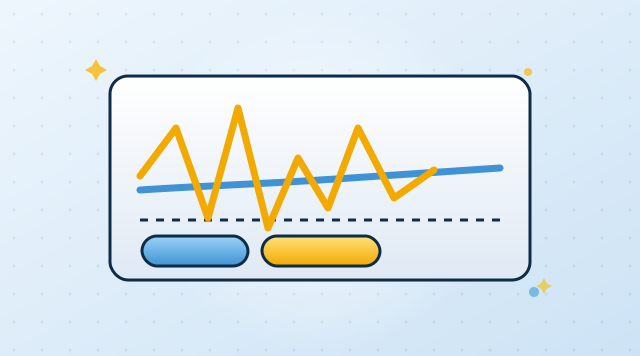
They measure different things. The house edge is the percentage of each bet a game keeps on average: it tells you what playing costs. Volatility tells you how far the real result can stray from that average over a short stretch. Two games with the same edge can feel very different, and a lower-edge game can cost more on a given night if you play it differently. The figures come from Wizard of Odds (consulted 24 November 2026) and from our game pages; anything we calculated ourselves is marked as an estimate.
House edge: what playing costs on average
The sum is simple: total bets × edge = expected loss. Four reference points:
- European roulette (one zero): 2.70% (1/37) on all bets. In Lightning Roulette the straight-up without a multiplier pays 29 to 1 and the published RTP is 97.10% on that bet and 97.30% on the others.
- American roulette (two zeros): 5.26% (2/38), except the 0-00-1-2-3 bet, which rises to 7.89%.
- Eight-deck baccarat: 1.06% on the Banker, 1.24% on the Player and 14.36% on the Tie. The edge is defined as expected loss on the initial bet, ties included. You will see it in Speed Baccarat, where the Banker returns 98.94%.
- Blackjack: it depends on the rules. In Infinite Blackjack the published RTP is 99.47% with optimal strategy, an edge of 0.53%.
On ARS 100,000 wagered (100 plays of ARS 1,000), the expected loss is ARS 2,700 on European roulette and ARS 5,260 on American. In baccarat at ARS 2,000 a round for 100 rounds (ARS 200,000 wagered): ARS 2,120 on the Banker, ARS 2,480 on the Player and ARS 28,720 on the Tie. That is why the Tie is the most expensive bet on the table even though it pays 8 to 1.
Blackjack: 3 to 2 versus 6 to 5
The payout on a natural blackjack is the rule that weighs most. According to Wizard of Odds, moving from 3 to 2 to 6 to 5 raises the house edge by between 1.36 and 1.39 percentage points depending on the other rules: in a game with Las Vegas Strip rules, from 0.46% to 1.82%.
The direct sum confirms it. A ARS 2,000 bet pays ARS 3,000 on a blackjack at 3 to 2 and ARS 2,400 at 6 to 5: ARS 600 less. A natural turns up in about 4.8% of hands (standard estimate), so the cost per hand is 0.048 × 0.3 = 1.4% of the bet, consistent with the Wizard of Odds figure. Over 100 hands of ARS 2,000 (ARS 200,000 wagered), the expected loss goes from ARS 920 to ARS 3,640: ARS 2,720 more. Always check what the table pays; the rules listed on our Infinite Blackjack page give 3 to 2.
Volatility: how far your session strays from the average
The usual tool is the standard deviation: a measure of how much the result of a bet varies around the average. Over n plays it scales with the square root of n. Here are the sums for 100 plays of ARS 1,000 on European roulette:
- Even-money bet (1 to 1): the deviation per play is about 1.0 bets, so over 100 plays it is about ARS 10,000. With an expected loss of ARS 2,700, a typical range (one deviation each side) runs from roughly a ARS 12,700 loss to a ARS 7,300 gain.
- Straight-up (35 to 1): the deviation per play is about 5.84 bets, so over 100 plays it is about ARS 58,400. Same average loss (ARS 2,700), but the range runs from roughly a ARS 61,100 loss to a ARS 55,700 gain.
Same edge, same expected loss, a range almost six times wider in the second case. These are estimates using a normal approximation that is weak for the straight-up with only 100 plays (you expect to win about 2.7 times), but they show the order of magnitude. Over 100 rounds of ARS 2,000, the deviation is about ARS 18,600 on the Banker (0.93 bets per round) and about ARS 22,800 in blackjack (1.14 per hand).
Do two slots with the same RTP play the same?
In slots, RTP says nothing about the shape of the payouts. An example with assumed numbers, not published by any provider: two games with a 96% RTP, an ARS 500 bet and 200 spins (ARS 100,000 wagered, expected loss ARS 4,000).
- Game A, low volatility, with an assumed deviation of 2 bets per spin: for the whole session it is ARS 1,000 × the square root of 200 (14.1), about ARS 14,100. The typical range runs from roughly a ARS 18,100 loss to a ARS 10,100 gain. It pays often and small.
- Game B, high volatility, with an assumed deviation of 10 bets per spin: for the session it is about ARS 70,700. The range runs from roughly a ARS 74,700 loss to a ARS 66,700 gain. Many spins pass without a prize, and now and then there is a big one.
With a budget of ARS 20,000, game B can exhaust it very quickly even though its average is the same. That is why bet size should be set from your balance and from volatility, not RTP alone. How mechanics change variance is covered in Megaways, tumble and Hold & Win, with examples such as Gates of Olympus 2500 (high volatility per several sources) and Starburst (low).
Which one to look at first
House edge helps you estimate the cost of an hour of play, as how to read the rules of a live table shows. Volatility helps you decide what balance and bet size to sit down with. Neither predicts a night’s result. RTP has its own article, RTP explained with real examples; by game type, see roulette, blackjack and baccarat.
What we could not verify
- Numeric volatility of slots: providers do not publish it; games A and B are hypothetical.
- The exact rules of each live table, which vary by operator; we use standard deviations as an estimate.
Edge percentages are from Wizard of Odds and our game pages; the deviation ranges are our own sums using a normal approximation.
Content for adults aged 18 and over. Gambling is not a way to earn income. If you need help, Línea 141 (Sedronar) is available; more information in responsible gambling.





 Responsible gambling


