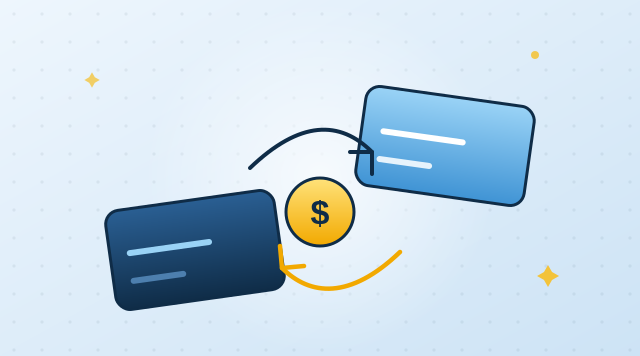
What is the difference between CBU, CVU, alias and DEBIN?
A CBU identifies a bank account, a CVU a wallet account, an alias is a shortcut to either, and a DEBIN is a charge you accept. They matter at a casino because many ask that the payout account belong to the same holder who was verified. The definitions are the BCRA’s, from its rules and its retail-payments glossary.
- CBU (Clave Bancaria Uniforme): a 22-digit code that uniquely identifies a bank account. Its digits convey the account type and number, the bank and the branch.
- CVU (Clave Virtual Uniforme): a 22-digit code that supports interoperability between users of payment service providers (the wallets) and of the financial system. Its first block identifies the provider and the second the client.
- Alias: a short code uniquely linked to a CBU or a CVU, used to transfer without typing the 22 digits. Under the rule it has 6 to 20 characters (letters, numbers, full stop and hyphen) and is unique across the system.
- DEBIN (immediate debit): an online transfer in which the payee initiates and the payer only has to accept. Authorisation can be given operation by operation or on a recurring basis.
How they relate
The BCRA rule says each CVU is tied to a client identifier, to an alias and to the CBU of a sight account in the name of the payment provider. In practice, a wallet balance sits in an account of the provider, and the CVU identifies it as yours. Transfers involving a CVU must be able to run on the same terms as those between CBUs. An alias can be reassigned to another account of yours (one change a day and up to ten a year), but it cannot pass to another person.
When you enter an alias to transfer, the app must show a confirmation screen with, among other data, the recipient’s real name, the destination bank and their CUIT, CUIL, CDI or DNI. That screen is your best check before confirming.
DEBIN at the cashier
With a DEBIN, the casino or its payment provider creates the debit request and you accept it from your bank or wallet. The consequence is that you do not have to copy account details, but the request arrives at your account and you are the one accepting it. In our files, Betano and Betsson list transfer or DEBIN among their deposit methods. The DEBIN rules have changed since it was created (for example, in 2019 it was simplified and the “pre-authorised” mode was renamed “recurring”), and how each bank applies it today is Not verified. More under DEBIN and bank transfer.
Why the holder matters for withdrawals
Locally authorised casinos ask you to verify your identity and, in several cases, that the account receiving the payout belong to the same holder. According to the documentation reviewed, Jugadón pays by transfer to a CBU or CVU of the same holder, BetWarrior pays to a registered bank account and checks against the registered holder, and Betano verifies the account and its holder. It is not only a commercial preference: the consolidated text of UIF Resolution 194/2023 lists among its alert signals that a bettor tries to operate with a financial payment instrument held by a third party (article 37). The rule does not require rejecting every account held by someone else, but it requires the operator to assess it, which is why many prefer to avoid it.
The practical consequence is concrete: a withdrawal can stall if the destination account does not match the person who was verified. How each operator checks that match (name, CUIT, DNI) is not in our files: Not verified. Being able to deposit from an account does not confirm you can withdraw to it; see why your withdrawal shows as pending.
An example with ARS 35,000
You deposit ARS 20,000 from a wallet account (a CVU in your name) and, at the end of the session, the casino balance is ARS 35,000. You have three possible payout accounts:
- A bank account in your name (CBU): it matches the verified holder. This is the route Jugadón describes.
- The same wallet you deposited from (a CVU in your name): it matches the holder, and Betano states that in PBA it allows withdrawing to Mercado Pago if it was used to deposit. Other casinos do not document this.
- Your partner’s or a relative’s account: it belongs to someone else and is the one most likely to cause a delay or a rejection.
These routes depend on each operator and province; the example shows the criterion, not a promise.
Mistakes worth avoiding
- Depositing from someone else’s account “for convenience” and requesting the withdrawal to your own, or the other way round.
- Typing an alias from memory and not reading the name on the confirmation screen.
- Using an account with several holders without confirming whether the operator accepts it: Not verified.
- Switching wallet or bank between deposit and withdrawal without telling support.
- Assuming a wallet’s CVU is a bank account: it is an identifier for a payment account.
For Mercado Pago specifically, see Mercado Pago at casinos and the method page. For identity checks, which documents you may be asked for.
What we could not verify
- How each casino checks the match between the verified holder and the payout account.
- Whether they accept accounts with more than one holder.
- The limits and fees of each route: we did not record them.
- The current scope of DEBIN at each bank and cashier.
Sources: the BCRA consolidated text “Sistema Nacional de Pagos – Servicios de pago” and its retail-payments glossary; a legal note on BCRA Communications “A” 6697 and 6698; the consolidated text of UIF Resolution 194/2023; public documentation of the casinos cited. We did not check how each operator matches the account holder with real withdrawals.
Content for adults aged 18 and over. Gambling is not a way to earn income. If you need help, the 141 line (Sedronar) is available; more information in responsible gambling.



 Responsible gambling


